Showing posts with label science. Show all posts

Thursday, February 11, 2016

Blogging for Thor: Deadly, Deadly Chromium!

6 hour exposure of dichromate test print
After my Facebook conversation last week with Johannes Schmidt, I decided to investigate the interaction of dichromate and salt printing for myself. The flaming reds and oranges he was able to get from dichromate make a perfect contrast to the verdigris green that solarized silver salts can produce with sufficient exposure!

So, I made a small salt print (the normal way, with 3% kosher salt), then added a drop of 5% ammonium dichromate to the top left and a drop of 5% potassium dichromate to the bottom right. In the middle of the print, I sprinkled the cream of tartar. Cream of tartar is chemically potassium bitartrate (KC4H5O6), which is a form of tartaric acid.

Again, my discussions with Johannes suggested that adding tartaric acid to a salt print should produce some variations of color. In the future, I'll test this further by mixing up a tartaric acid solution, probably just cream of tartar in water. Then I'll coat that solution onto a salted paper, in addition to regular sodium chloride.

Just to add some variety, I put a Red Nightshade leaf onto the salted, dichromated and tartarated paper. Then I exposed the paper for about 6 hours in sunlight, from dawn till around noon. Once I'd scanned the image after the first exposure, I let it sit out in sunlight (without the leaf) for another 2 days before I scanned it again. I've continued to leave it unprotected, so I'll be scanning again in a few weeks.

After 2 hours, the red color in the dichromate was lovely. Unfortunately, after the two days of sunlight, the dichromate had turned mostly violet, while the silver was the expected green. The cream of tartar had left slightly darker spots, but I'm not sure if that's just because it affected the original 6-hour exposure, or if it chemically created a reaction. Further testing is required!

I also did some tests on Potassium Iodide and Potassium Chloride salt prints. I'll have those results up on Flickr in the near future. They haven't been washed and fixed, yet. That's on the agenda for today, though!

Wednesday, February 3, 2016

Blogging for Odin: Orderly Presentation


Well, Spiders, I'm a bit late with today's blog. Six days late, actually. Unfortunately the only excuse I have is that I simply didn't get around to editing all these images and patching them together into a cohesive scan. The beginning of the semester has been a little stressful, and I've been trying to keep it all together. But, I do hope to have an entry for tomorrow, too!

After my experiments with photograms, I decided I needed something more controlled to really do a proper test of these different halide solutions. So, I created a little digital "test sheet"that has a smooth white-to-black gradient, a 15% medium grey bar, and a six-step zone chart that has 100%, 80%, 60%, 40%, 20% and 0% black. Using this test sheet, I can tell if one compound has more contrast, less contrast, exposes faster or slower, and get a much wider range of tonality than by using photograms. I'm also controlling the process further by printing in one of the university's UV exposure boxes, instead of in sunlight.

So far, my results aren't mind-blowing or anything.

The potassium iodide (KI) is really.. ugly. I mean, there's just not anything redeeming about it, especially not once it's been fixed. Maybe it's nice in the "latent" form, just after exposure, but even just a salt water wash makes it muddy and unpleasant. Fixing it just turns it to a dull, rather hideous brown.

Ammonium chloride (NH4Cl) is extremely similar to sodium chloride (NaCl). The only difference I can see, and it's quite subtle, is that the ammonium chloride seems to be a little bit warmer. There are two tests for ammonium chloride because the first test had some pretty hideous staining. The second test, though, was slightly compromised because I waited a full day between exposing it and fixing it. This almost certainly caused some fogging in the paper before the fixing.

Bromo-Iodizer has the most interesting results, providing warm yellow highlights and soft brown shadows. I can certainly see some uses for this coloration, but I'm personally not a huge fan. I do like the long-exposure greens that it produces, but I'm not sure if I like it enough to continue working with the Bromo-Iodizer. It's quite nasty stuff, and I may be able to get similar results by simply using potassium bromide and potassium iodide together, without the presence of alcohol or cadmium.

Assuming that I've recovered from my current head-cold by tomorrow, I'll be giving a test to potassium chloride and potassium bromide, both of which arrived recently. I was able to mix up a 3% solution of both, coat and dry some test sheets, but didn't have time to apply the silver nitrate or do a test exposure. So those salted papers are waiting for me in the lab!

Toss some positive vibes my way, Spiders. I could use 'em for this little plague.

Thursday, January 14, 2016

Blogging for Thor: What's in a Halide?

The three common silver halide precipitates:
AgI, AgBr & AgCl (left to right)
Hey there spiders! I'm gunna hit you with some SCIENCE!

Modern silver gelatin photography uses the term "silver halide" a lot. In film and in paper, the term gets tossed around in reference to the light sensitive salt used to make photographic images. "Halide" is not a specific chemical, though. There's no such element as "Haline" on the periodic table. Instead, "halide" refers to a group of chemicals: chlorine, bromine, iodine, fluorine, and astatine. So a silver halide is a silver compound with any of those five elements. Two of the silver halides are weird, so I want to go into detail on them!

First off, silver astatide isn't used in photography because astatine is extremely radioactive and compounds using it decay in a very short time. So, while silver astatide does exist, it isn't physically feasible to use for any practical purpose. The short half-life of astatine means that it's difficult to study even in laboratory situations, so the light sensitivity of silver astatide isn't even well documented.

The other weird silver halide is silver fluoride. It exists, it isn't radioactive, but it still isn't used in photography... for the most part. Silver fluoride exists in three forms: disilver monofluoride, silver monofluoride, and silver difluoride. None of these forms of silver fluoride are useful in traditional photography, primarily because they react with water. Depending on the specific fluoride compound, they will either oxidize violently or break down via hydrolysis. Because of the inability to use silver fluorides in combination with water-based chemistry, silver fluoride was long ignored in photography. However, in 1966 a US patent was filed for a process where silver fluoride could be vacuum deposited onto a surface along with gold, and treated with boron trifluoride vapors to create a high-resolution, extremely low-speed photographic surface. It appears, though I'm not an expert at deciphering patents, that this research was carried out in connection with the Polaroid Corporation, by a scientist named Joel M. Peisach. I've had no luck tracking down any further literature or contact information regarding this process, and certainly no examples. It's extremely disappointing, even if the complex process and materials required put this technique far outside the reach of anyone working outside a laboratory environment. Still, it was really, really cool to find out that silver fluoride photography does exist.

Silver chloride, silver iodide and silver bromide are all widely used in different forms of photography. Each compound produces different tonal ranges, color palettes and contrast ranges and functions in different photographic processes. Generally, silver chloride is the form used in salt printing.
Why the big science dump, Spiders? Because I'm all about breaking the rules and getting into the how and why of things. So, who's to tell me that a salt print uses silver chloride? Why can't it use silver bromide? Or silver iodide? Or a combination of two halides? Or all three halides? Why can't it be as halide happy as it can get, Spiders? It's about to get like that, Spiders. I'm searching for ways to make "salted paper" images using silver bromide and silver iodide in addition to, or in place of, silver chloride.

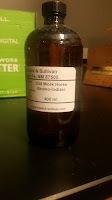
Fortunately, I found this weird stuff called "Old Workhorse Bromo-Iodizer" in my university's alt process lab, and I found Potassium Bromide for sale from Bostick & Sullivan. I need an iodide solution, but I'm sure I can find it. After all, iodine isn't exactly hard to get a hold of. This is going to get crazy, Spiders.