Showing posts with label exposition. Show all posts

Thursday, May 26, 2016

Blogging for Thor: Writing in the Dark

Skotograph by Madge Donohoe, 1920s-30s.
What should I blog about, Spiders? I ask myself this every week that I haven't got an on-going experiment or process that I'm fiddling with. Earlier today, I was considering a post about lumen prints made primarily with opaque objects, like fruits and vegetables. The primary exposing agent in such a case would be the chemical interaction between the photo paper and the bio-matter, not light. Light might expose the uncovered areas of the paper, but anything that happened on the covered areas would be explicitly chemical. That's interesting to me, since it's photography without light. That should be impossible, right? Photography without light is... what? Chemistry? Chemography? Or... Skotography?

I looked up what the Greek root-word for "darkness" would be. Skotos, it turns out. Then, I had to wonder if 'skotography' is a word? Yes. Yes, it is. It's two words!

Scotography (another way to spell the same word, because going from one alphabet to another is a bit flexible) is the medical practice of using non-visible wavelengths of radiation to create images. X-Ray photography is, therefor, scotography.

There's also Skotography, which was a spiritualist practice in the late 1800s and early 1900s. The idea was that, in darkness, spirits could project energy onto photographic material and produce images. Skotography was the high-tech version of a seance, or table-rapping. Treating photography as magic has a long history, about as long as the history of photography itself. Today we have 'aura photography' or Kirlian photography. And ghost-hunters that use their cameras to image the supernatural. And, there are, of course, still people who believe in skotography.

People are weird, but the few supposed skotographs I've found are actually fairly interesting in appearance. There's even a French artist who is doing a modern project inspired by the work of Madge Donohoe, a popular skotographer during the 20's and 30's.

Monday, May 16, 2016

Cameras and Caramel

Caramelized sugar, the product of thermal decomposition. SCIENCE!
Today I came across an absolutely awesome blog: Serious Eats. They are serious about cooking, as they should be. It's serious stuff. Even though my MFA thesis project is created with food, it does seem odd to feature a cooking blog on a photography blog, doesn't it? No. It doesn't. Shut up, Spiders.

One of my oldest friends shared an article from Serious Eats: How to Make Rich, Flavorful Caramel Without Melting Sugar. And it's everything I love. It's food, it's science, it's kitchen-friendly, and it's easy! I was so excited after reading this article, that I had to share it with everyone. All my friends, my Instagram followers, and you, my lovely Spiders. It seemed, though, that most people were not as blown away as I was. So, I'm going to explain why this article is amazing.

It's the science of an ordinary process (caramelization) being dissected, studied, and used to make something far more amazing than you could manage without understanding what is really happening. It's about not being satisfied with the surface, and digging deeper into the mechanics so that you can really take control of a situation.

The writers at Serious Eats are, like Alton Brown, showing that cooking is all about chemistry and physics. There's another article where one of the writers goes in-depth explaining why bleached flour has its place and why, in fact, the bleaching is entirely useful. It's sometimes essential to use bleached flour. Until reading it, I assumed that bleaching flour was just an aesthetic concern. It isn't! It causes important chemical changes in the flour that give flour new capabilities.

How is this all relevant to photography? It's relevant because all photographers should ground their practice in a thorough understanding of how their tools work. If you don't understand the physical processes involved in photography, you're not going to be able to exploit them properly. You won't be able to end-run around problems, or bend the mechanics to your advantage.

Take something simple like a lens flare. If you understand why and how lens flares happen, its easy to avoid them when you don't want them, and control them more precisely if you do want them.


...Oh, and I'm absolutely going to try burying a sheet of photo paper under a layer of sugar, caramelizing the sugar, and seeing what the resulting chemigram looks like. I will not eat the caramel sugar produced, because it will probably absorb some nasty chemicals from the photo paper. I do have high hopes for this idea, though!

Friday, May 13, 2016

Blogging for Freya: Beyond Beginnings

Three Cheeses – Digital Scan
I find the obsession with original prints a little odd for photographers. Recently, as part of my graduate school program, I had a year end review of my current thesis project. I make lumen chemigrams which are inherently unstable, and can't be chemically fixed without altering their appearance. So, for the images to be viewed later, they have to be digitally imaged and reproduced. The "original image" is transitory, because even if stored in a dark environment, the prints continue to develop and change due to chemical residue from the food used to create them. The digital image is the "final print" because the physical print is a dynamic event. So why are people hung up on wanting to see that print, not the digital version?

In every understandable way, the digital image is the photograph. It's the final print. The original, food-covered paper, is not really a 'print' at all. It's my subject for a photographic image. It's not actually a photographic print in any useful way, since it can't be viewed in its "actual" state for more than a few minutes. It's not much different from a sand mandala or water calligraphy. If you're there when it happens, you can see it. Otherwise, the only way to experience it is through a photographic reproduction.

And yet, repeatedly, the panel of reviewers were upset that they couldn't see the "original" prints. They made the assumption that the original prints must have more depth, more texture, more dimension, richer colors... but they don't. Honestly. I've seen them, I work with them, I scan them. In almost all the cases, there's no visual information in the "original" that isn't in the photographic reproduction. The only significant difference is that the paper surface of the "original" might have a different texture, tooth or reflectivity than the digital print. 

But, dang, the reviewers were fixated on the idea of seeing the "original". I was even accused of teasing the viewers by 'dangling' the idea that there was an original print at all. You need to know that there is a subject print, to understand what's happening and what I'm doing, but you don't need to see that subject print. Generally because, by the time I've finished everything and am presenting the work to an audience, those subject prints are no longer anything like the image you're seeing. They've lost contrast, lost color, sometimes completely decayed into dull swirls of brown and grey. They're not interesting anymore.

This odd fixation on the idea that there is some inherent merit in the "original" print just because it is original is so strange to be. Photography is all about reproduction. It's all about making an aesthetic choice to capture a single moment of some event and present it to others, far removed in time. If you're going to demand to see the "origin" of any photographic image, aren't you questioning the very reason that photography exists?

Thursday, March 31, 2016

Blogging for Thor: A Recipe for Success

Hello Spiders. As you know, because you read everything I post online, I have been struggling with graduate school. I've always struggled to fit into the Fine Arts community, and it's been particularly bad this year, after not having to worry about it for six years or so. I've been more focused on education, community engagement, experimentation, learning and process. But to succeed in graduate school, I need to be thinking about conversation, experience, presentation and conceptuality. Super fun, right, Spiders?

It was speaking with David Hilliard, the visiting artist for my graduate class, that I was finally able to articulate these difficulties and start coming to a resolution. I've been looking at work by people like Alison Rossiter, Chris McCaw, Brittany Nelson, Marco Breuer, and Christina Z. Anderson. What I needed to do was focus less on the process as the work, and more on the finished image. I'm turning things around and using the techniques I love to make images that are beautiful and engaging on their own.

After talking with David, I went back through my archives and started looking for the really unique, engaging images. I settled in on the food-based lumen-chemigrams that I began experimenting with two years ago. There's a small gallery of them on my Flickr (LINK), but I never really pursued the idea. It was fun, though, and it actually meshes very well with what I've been doing recently at grad school.

My nod to process, and to experience, is to frame my prints as the product of a recipe. The prints exist as themselves, pieces of art to be visually engaging and aesthetically stimulating. But, with each print, there is a recipe. The materials and process used to create that print, listed plainly. In fact, there is literally a recipe, on a recipe card. I work in the kitchen, that's been the center of my process since I left undergrad. Everything I've been doing has been safe for the kitchen, and generally the kitchen has been my darkroom. I carry the same experimental desires I have with photography into cooking, so why not bring things full circle?

The recipe cards I've been making for each print frame the print as a product of my own past, my interests, events in my life and hopes for my future. The same way a cake recipe might be "Kathy's Birthday Cake" and carry with it all the significance of the event it was created for, my photographic recipes are things like "Orange Rice Mitochondria" and carry with them my memories of a favorite book (A Wind in the Door by Madeleine L'Engle) as well as representing my interest in biology, science and evolution. Each recipe carries a personal snippet that ties the image back to my life.

So, seriously Spiders, this shit better be Fine Art. Because, I'm actually enjoying it, and I am tired of starting over.

My main task is going to be creating new prints despite terrible weather (apparently New England does not believe in sunlight until July or something..) and tying the appearance of the print to the actual driving force behind the print. My next piece, pH Balance Of Milk And Citrus, needs to actually incorporate the ideas of balance, chemical forces, and somehow reference the destructively complementary nature of acids and bases. Fun, right? Actually... yes!

Friday, July 17, 2015

Blogging for Thor: Salted Sadness

Sweaty and squinting was the whole day.
Hello, Spiders. I've been feeling unwell and generally pre-occupied either with grad school, moving, loans or medical issues. Thus, two missed weeks of blogs.

Despite that, I have been making (or trying to make) art! After the salt prints at my workshop failed, I decided to figure out why. Well, I determined easily enough that it was the paper. So I switched to a different brand (Arches Aquarelle Cold-Press Blocks) and the coating went well. The exposures went well. I got great images with full detail and tonal range... until I fixed them. As soon as I fix any of these salt prints I've been making, they darken dramatically. All the whites turn beige at best and dull brown at worst. Some of the images disappear entirely. They're fine before the fix, and ruined afterwards. I really can't pin down what's going on. So, figuring out the salt printing issues is one artistic challenge on my plate.

In other news, I attended my first local artist market as a vendor. It was hot, sticky and not very profitable. I only sold $31 worth of prints (three total pieces) and all to people I knew. So I wasn't that excited. But, one of those people was a friend I'd known years ago while taking typography classes at the local community college. Now she's working at a handmade boutique in the Charlotte arts district. That's great, and she seems to really love her work. She also loves my work, and bought two of my pieces. She'd reached out to contact me via the Facebook advertising for the art show even before she realized who I was. So this coming week I'll be meeting with her and the owner of the boutique to see if they'd like to sell my work. Cyanotype totes, parchment prints and the cyanotype jewelry, mostly. Maybe some of my textiles.

Even if the show didn't work out, I'm hoping this new opportunity will! I'll keep you posted on the shop and the salt, Spiders!

Thursday, May 7, 2015

Blogging for Thor: It's Hammer Time

The countdown begins! Rather arbitrarily, I do admit. My work for the Community Supported Arts grant is due on May 18th, in just 10 days. It isn't that I can't do math, by the way, I'm just not counting the last 40 minutes of today as a day. So in 10 days, I must have thirty parchment prints mounted on wood, along with twenty pieces of cyanotype jewelry.

I decided that, after talking with a lot of other artists, I was going to compromise on the issue of how to fasten down the parchment. My current plan is to do a third of the parchments with brass nails, a third with steel nails and a third with the liquid hide glue I got from Woodcraft. Liquid hide glue, by the way, stinks horribly. It does appear to be holding a stable, very strong bond, though. It was recommended by the tannery that provides my parchment. It's doing far, far better than the E6000 or the Yes! Paste, both of which gave up within days.

So where do I stand, Spiders? Today I finished mounting and putting hardware onto 17 of the 30 parchment prints. I want to give the hide glue test piece a bit more time to see if I want to reserve 10 of those as glue-only, nail-free presentations. I finished 10 mounts with steel nails and 7 with brass nails. There's 13 prints waiting under a stack of encyclopedias, all ready to go. I'll assemble the other 3 brass-nails prints tomorrow.

The jewelry is almost finished, too. I have 1 set of earrings, 7 rings, 3 metal pendants and 9 wooden pendants. The last of the metal pendants and 5 of the rings are waiting for resin, which I'll probably be pouring tonight, after I finish this blog post.

In total, I have completed 62% of the project. The rest is all very close to the finishing stage. My only remaining concern is any mistakes in assembly or finishing that crop up. Today I managed to hammer one of the steel nails down wrong, and I may have to scrap that mount. Fortunately, I have extra wood and enough time to replace the piece. Of double fortune, it wasn't one of the best prints. So, not a terrible deal. Just annoying. I might end up replacing it with an extra piece of jewelry, assuming I can find the stash of first-run wooden cyanotype pendants I made. The second run, currently strung, is not as dark blue. The third run, now bleaching, was too blue. There's an unfortunately high failure rate with the wet-printed wooden pendants and tags. I can't figure out exactly why. I'm guessing that it's to do with the "wet" part of wet-printing.

Thanks to a lovely overcast sky, I was also able to document everything that I've finished so far. My lovely Flickr gallery grows as I near project completion! Y'all should check it out, Spiders!

My last bit of work will be ordering more burlap bags, getting some better raffia stuffing (this stuff is too long and stringy!) and then finish the insert that I'll be handing out. It should be the work of a day to stuff everything once it's done.

I'm so excited, Spiders. My first grant, and I'm coming in way under budget and right on schedule! I'll be so happy to finish this project, even though it's been very fun.

Saturday, May 2, 2015

Blogging for the Baron: Nailed It?

My favorite haul from Liberty! An antique printer's tray!
Hello, Spiders. I've been away for a while, but it's actually been good reasons. Last week I missed my deadline because I was on my way to Liberty Antique Festival with my best friend, Tiffany. We try to go once a year. Since I'll be moving this fall, this was my last time. It's very sad, but this time around was pretty great. I found some gifts for my mother's birthday and Mother's Day (they're a week apart) as well as some cool stuff for me. Successful antiquing, if I do say so myself.

Then, after I got back, there was gaming with friends. Following that, I had to prepare for a check-in with the Arts and Science Council folks that are running my grant program. Following that I had a minor crisis about my grant project (detailed below!) and then I had to deal with the final exam for my students. Even more recently, I went to see a live show of Megan Jean and the KFB. I've been just swamped. It's just been a busy time recently. But the majority of my recent activity has been productive. The crisis sparked a lot of work; I've made a big push on the grant project.

The vile betrayer, now repaired with more
epoxy. I'm waiting to see if it fails again.
Anyway, let's talk about my crisis, shall we? Up until last Sunday (April 26), I had been planning to simply use E6000 silicone epoxy to glue my parchment cyanotypes down onto the slices of osage orange wood that I'll be using as mounts for the grant project. I'd done a test piece and it was doing just fine after several weeks, showing a strong bond and no odd developments. Then, on Sunday evening, I went to photograph the test piece with my DSLR for a higher resolution image. The whole upper half of the parchment had bubbled up and the edges weren't laying flat at all. I was able to easily peel the upper part of the print off the wood with my fingers. The lower half was still fairly stuck down, but having half your art peel off the backing isn't acceptable.

I began to panic. I only have until May 18th to have all 50 pieces produced and ready for the recipients. If a friggin industrial epoxy wasn't going to hold parchment to wood, what could do the job? I hit up Google University, Facebook discussion groups for artists and contacted the tannery where I buy my parchment. Most of the conservationists, woodworkers (parchment is used in some furniture applications) and the tannery recommended using a more flexible, water-based glue. Hide glue, wheat paste, PVA (PolyVinyl Acetate) glue, carpenter's glue, or Yes! paste. I decided to try the Yes! Paste and had great results. The glue applied easily, the parchments appear to be fully adhered.

Except... in further research, I've found that opinions on Yes! paste are sharply divided. While the product, and many reviewers, claim that it is archival, there are a number of conservationists who strongly oppose the use of it. They say that within a decade or two, it begins to yellow and turn brittle. I'm not very concerned about the yellowing, since it's hidden under opaque parchment and unlikely to be able to change the color of the parchment itself. I am quite concerned about the brittleness, though. I don't want the art to fall apart on an owner's wall.

No glue, just nails. Good? Bad? I think it needs 2 more.
There is another idea, which lead to the title of this entry: nails. While I was panicking about what to do instead of glue, I scoffed "I can't just nail it down!"...  except why can't I just nail it down? So I went to the hardware store, purchased a variety of small tacks and pins, and set to work. I nailed down two different parchments and, even without a glue base under the parchment, the nails do an excellent job of keeping the parchment flat. Nails aren't going anywhere. The only problem is that... uh, well, there's nails in my art now. I didn't plan on that, and I'm not sure I like it. They aren't particularly obtrusive, but they're certainly there.

I've been asking around for feedback on the whole nails vs glue thing. A lot of folks have suggested that I make the nails more visible, using brass or copper nails that stand out and complement the color scheme. Or that I use the nails to pull the skin taught as it dries, instead of just using them to hold already-dry parchment in place.

Of course, now I've already used the Yes! Paste on 17 of my prints. Even if I buy some hide glue, which is supposed to be ancient-Egyptian-caskets permanent, at least 17 of my prints are already glued down with a suspect adhesive. So what I'm thinking now is that I won't be consistent. I'll do some of those 17 with regular steel nails, some with brass, maybe even some with copper. Some of the other 23 will just have glue. I don't have to be consistent. I'm already splitting the 50 pieces between wearable art and wall art. The wearable art isn't consistent. Some rings, some pendants, some earrings, some silver, some wood, some brass... I think that I am OK with this body of work being fairly diverse. I'm really looking forward to wrapping it up in the next few days. Then I get to to through and document the whole thing.

Do any of you Spiders have opinions on the whole nails issue?

Left: No Nails. Right: Nails. Which is better?

Sunday, April 19, 2015

Blogging for Sol: Raining on the Panda Parade

Odd Bleaching, Reason Unknown
Hello, Spiders! This week has been pretty terrible as far as weather goes. Even my students have been complaining, because the weather makes it harder for them to do extra credit assignments. I give them the opportunity to do alternative process (cyanotype, lumen, anthotype or scanogram) prints for extra credit... and they all wait until the last week to do them. Of course.

So, I haven't been doing much printing lately. Nor have I made much progress on the grant project recently. I have begun to epoxy the printed parchments onto the wood, though. The first test finished curing tonight and it shows no ill-effects on either side. There's strong adhesion and everything appears to be going well. Recent grant-related developments also include 3 failures which I'll have to re-print. That's going to be challenging, since most of the last shipment of parchment was small pieces. I do have a large sheet I can cut from, but the surface isn't what I'd like... so I'm ordering another set of parchments and hoping I get some bigger bits. I'm going to include a note asking for no sheep scraps.

What I did get done was some catch-up on my documentation. I've been doing a lot of experiments with the different types of parchment and prepping for the grant work. So I had a double handful of parchment prints waiting for scans. I finally got that done! In case you were wondering, Spiders, I do not like Sheep Parchment.

In a related note, the odd fading that I've discovered lately (Mexican Heather 8, Peppervine 5) is finally scanned. I'm going to be seeing if anyone, like Christopher James or Mike Ware, can explain what's causing this reaction.

Thursday, March 19, 2015

Blogging for Thor: Milestones

Go Lesley University Lynxes! Apparently?
Hello there, Spiders. You recall how I've been complaining about graduate school? Well, now I have a new complaint: Boston is expensive as hell! Why does this matter? This matters because I've been accepted to the MFA program at Lesley University. I'll get to study with Christopher James, Dan Estabrook and some amazing fellow graduate students.

When I got the news on Monday, I had to sit down for a bit. In 2013, I applied to two schools and was rejected. The same thing happened (at two new places). It was through the Facebook Alternative Photographic Processes group that I learned of Lesley's program. Christopher James, who I can't stress enough, is the guy that wrote the book on alternative processes, suggested that my work seemed like a good fit for Lesley. He was supportive and encouraging during my application process and I'm so happy to be headed up to the north this Fall.

Now I just have to find a place to live up there, and a way to pay for everything. That's going to be a whole new series of challenges. Sure hoping that Senator Warren manages to pass some of those student loan reform bills she keeps yelling about! Go, Warren, go!

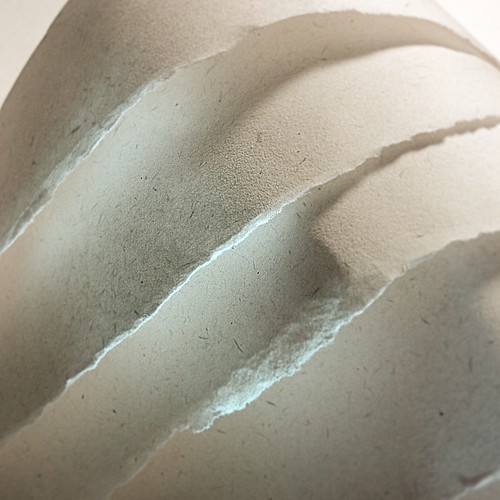
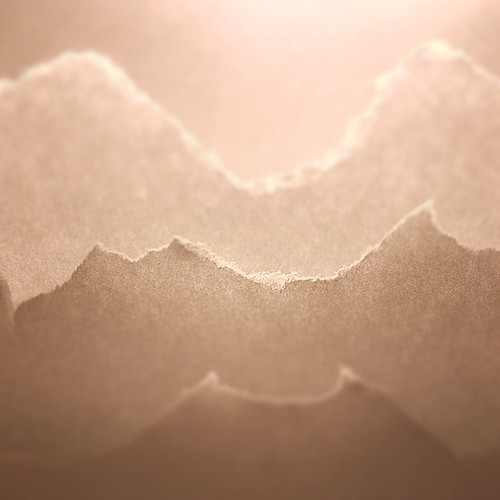
What else is there to report, my Spiders? Well, not much amazing. But I did recently break 150 entries in my Folded Paper Project (Flickr) that I've been working on using Instagram. That's 150 solid (ok, mostly solid) days of abstract paper photos. I'm pretty impressed with me!

Cheers, Spiders! I'll see you all next week!

Wednesday, March 18, 2015

Blogging for Waterfowl: An Eggcellent Opportunity

One of the goose eggs to be made into art!
My friend Troy Tomlinson was recently transporting some rescued geese and found that they had laid eggs in his vehicle. Troy reached out to the local artist community and five of us agreed to make egg art.

In my case, I'll be coating the egg with cyanotype chemistry, then taping some plants onto the eggs and making a Cyanotype Egg. I've managed to print on all kinds of weird things, but never goose eggs. This should be fun!

Jane Wiley, another local art friend, will be doing one of the eggs as well. She'll be doing Laser Transfer, or Tea Paper Printing!

Once they're finished, the eggs will be auctioned off to raise money for Carolina Waterfowl Rescue.

Friday, March 13, 2015

Blogging for Freya: Friday Failures

Well my dear Spiders, I don't have a post tonight. I have some things to post about, but I am very tired. I'm going to bed, like a responsible adult who has appointments and errands to get done tomorrow. Then, like an irresponsible adult, I'm going to a concert tomorrow night. So there will almost certainly not be a blog entry on Saturday. It'll be Sunday before I get anything of substance up. Hey, at least I have a timeline for my failures, right?

So look forward to an update Sunday regarding the new shipment of Osage Orange wood that arrived on Wednesday. I have some plans for it, and some of the pieces are just so tiny and adorable. With the weather turning nice, I can do a lot more printing because 1) there's sunlight, and 2) my studio isn't freezing anymore. My students have next week off for Spring Break, so I'm hoping to get a bunch of printing done. It oughta be super fun, and a big push towards finishing up my grant project.

Cheers, Spiders!

Thursday, January 29, 2015

Blogging for Thor: The Cloud is Our Friend

Hello Spiders. Today's update is small, but at least it'll be on time. I received a comment from one of you, an actual human Spider. At least, he sounded human. He brought up something that I've been noticing myself: some of the pictures on older posts have been disappearing. These are photos that I've linked to via Instagram, Flickr, or Facebook, so I assume it's those services (or maybe me) fiddling around with back-end stuff and messing up the links.

Well, that's kinda lame. If a new Spider wants to crawl around in the blog, they should be able to see the lovely photos and examples. So I've gone through and repaired all the broken links, uploading the troubled photos directly to the blog. I'll be doing this from now on, and checking regularly to see if there are any further broken links. If you see one, just leave a comment! I do love comments!

I actually have a real update for this week, but I want to give it another day or two. It's regarding some of the anthotypes I started exposure on waaaay back at the beginning of December. Winter isn't a good time to do anthotypes, but I figured I'd give it a whirl. Applying to grad schools and going over all my application packets always makes me incredibly twitchy, but it reminds me of the other two experiments that I'm working on. I generally only work on one at a time, so sometimes I forget. Cyanotypes have been eating my attention for months, but I figure come spring, I'll get back to lumens and anthotypes. Won't that be nice?

Seeya soon, Spiders!

Thursday, January 22, 2015

Blogging for Thor: Sickness and Ideas.

Hi there, Spiders. I'm very tired. I've been coughing pretty much non-stop for a month, and it's rather annoying. The doctor hasn't been a lot of help. I don't appear to have tuberculosis, bronchitis or anything else particularly nasty. So, just coughing. Maybe I'll cough my way to a fitter belly? Who knows. My diaphragm muscles sure are getting sore. Hopefully today's blog, posting on Thursday, will maybe make up for skipping last week entirely?

Artistically? I'm actually struggling with budgets and brainstorming. My grant came in, so I've got a decent amount of money to make fifty (50!) pieces of art. Well, it's a decent amount when you take it as a lump, but it becomes far smaller split 50 ways. The real issue for me is how best to present these items for shipping and handling while keeping them aesthetically pleasing, environmentally friendly and cost-effective.

The cost-effective issue is a big deal, mostly because I value my own time. It took me a lot of work to assemble the pieces for my show in Asheville. I don't want to go through that mess again. So I need to find a fairly simple way to present these prints. 

I'm splitting the 50 pieces into 20 wearable objects (necklaces, rings, scarves, earrings) and 30 traditional prints. Oddly enough, the prints are actually going to be the ones that require the most work. Assembling the ready-made jewelry with parchment prints is pretty easy. It's even easier using wood prints. Scarves, at least the small kind that I discovered for Christmas, are fast, too. For the prints? Those I have to make (easy, fairly cheap, takes time, though) and frame. The framing is the sticking point. I don't want to do traditional frames, glass and all, I want something simpler.

At the moment, I'm considering mounting the parchment prints on wooden blocks or artist panels. We'll see how that goes. While tooootally not cost-effective for this grant, I might use some of the left over money (ya know, the amount that goes to me for my time) to buy some interesting products. I discovered a company that makes exotic hardwood artist panels, and realized that you can use Etsy to purchase all kinds of stuff. I'm thinking some live-wood (bark and all) slices of osage orange wood would make a great background for some round prints. Wouldn't that be cool?

Any of you spiders know where to get logs of exotic hardwood... and a belt sander? I need those. 

Saturday, January 10, 2015

Blogging for Saturn: Baby's First Budget!

Parchment Cyanotype, Framed
Heya, Spiders! I know, I'm still late. I'm just really bad at writing during the days and now that I have a social life, I keep doing things on Thursday and Friday nights. It's a real issue... except for the part where I'm out, having fun with friends. So. Not a huge issue, really. Thor might be getting a bit miffed, though.

Today I'm blogging for Saturn, because he's the Roman God of (among other things) wealth and fortune. Why? Well, Spiders, I'm happy to tell you that I've gotten my first grant. The Art & Science Council of Mecklenburg County offered a grant for artists to participate in a Community Supported Arts program. I was selected as one of nine artists to be featured this year. I'll be making 50 small pieces of handmade art, to be distributed to the people who buy shares of the program.

For me, that means making 50 of my cyanotypes on parchment, wood and bone. In all honesty, I'm extremely unlikely to include any bones in the grant program. I'm only getting a budget of about $40 per piece; the bones are just worth too much to me. They're hard to make and the materials are a bit scarce. I'd rather use them myself. So, instead, I'll be making prints on wood and parchment for the grant program. My offerings will be a combination of the wearable art that I've been experimenting with, and the normal parchment prints that I've been doing for some time.

My biggest challenge is going to be the framing and packaging. I've got to keep my costs low, and my time fairly limited on each object individually. The type of display I used for my show in Asheville, seen above, is too labor intensive and costly as far as materials go. I'll need a simpler way to present the parchment prints. The wearable art will probably stick fairly close to the early test models, like the ones featured in the last two weeks. The material and time cost on that is pretty low.

Obviously there's going to be some research into how best to package everything, where to get the best value frames, how to assemble everything, what adhesives to use... but that's actually kinda fun for me. I'm excited, because if I can get this all down, then future work will be that much easier to make!

All of this is pretty amazing. It means I'm getting paid to continue with my experiments. I have a budget! I'm actually being paid to make art. Honestly, that doesn't happen very often for me. I'm very, very excited. You can rest assured that as I move forward with the grant, I'll be posting updates on the work made for it and what I learn during the process.

Thursday, December 4, 2014

Blogging for Thor: Aggregated Datas

Hello, Spiders! I'm feeling much better, and even doing some more anthotype printing. It's slow going, given the weather and lack of sunlight, but I'll manage. I scanned a small crop (4 prints) and I'm labelling and sorting the information now. I may post some results later this weekend.

In other news, a huge survey of alternative process photographers was completed, compiled and released recently. It has some very interesting information! Check it out Over Here. That post is in English, but the rest of the blog is in Dutch, which I do not speak. Still, it's nice to see another active alt. process blog!

The biggest point of interest to me regarding the survey is the split on the issue of what is and what is not "alternative" photography. For me, silver gelatin and color film processing (as base processes, not modified by something like mordançage) are not alternative. They're traditional photography. Digital is digital, film is film and alternative is "other". It's a clumsy, messy grouping, but hey, it mostly works. Artists aren't very good at deciding what to call things anyway.

Even more than the simple debate about film being alternative or not, is the divide on what else is alternative. Judging by the reported statistics, there is a not-insignificant number of self-identified alternative process photographers who do not consider historical photographic processes to be alternative. If they're not alternative... what is??

Some very enlightening, and very confusing, data awaits.

Friday, October 24, 2014

Blogging for Freya: Folding Paper

Folded Paper Project, Day 4
I've been working on a side project recently, Spiders. While attending SPESE-2014 I attended a lecture by Aline Smithson, the founder of the Lenscratch photo blog. She was talking about, among other things, about how she started her blog and how it's become one of the most popular and well-trafficked photography blogs online. She decided early on that she was going to write about a different photographer every day.

As you know, Spiders, I struggle to post a blog entry about any topic at all on a weekly basis. The idea of researching and featuring a different photographer every single day blows me away.

No, of course that doesn't mean I'm going to start posting more often. That's silly.

Still, the idea got lodged in my brain along with other things from the conference and from recent events. Finally getting an Instagram account, as I mentioned on Monday, was one such thing. It was largely motivated by the idea of getting my work "out there" via another outlet and potentially reaching other people interested in what I do. Another thing that was rolling around in my brain was the sheer amount of work being produced by some artists I keep in touch with, like Joshua White and John Fobes. I was also struggling with constantly trying to convince my students that, yes, they can make amazing photos and no, they do not have to go anywhere to do it. They can make interesting compositions right at their desks!
Folded Paper Project, Day 3

Those many things came together and I decided to start a new series: the Folded Paper Project. I started off with some rules for myself.

1) Take a new photo every day, using Instagram
2) Shoot only torn, cut or folded printer paper
3) Use only household light sources
4) Apply identical in-app adjustments to each photo

The most "advanced" tool I've used in the project so far is sticky poster tac to hold bits of paper in place for me, and a plastic ice cream bucket to act as a diffusion surface.

So far, the project has been quite fun. I haven't missed a single day yet, though for the Folded Paper Project, I'm measuring "day" by my sleep cycle rather than the 24-hour calendar. So if I don't get to the image until 2 AM, that's fine, because I haven't gone to bed and woken up the next morning yet! Honestly, Spiders, I think that is pretty much how I treat this blog, except I really do try to get it done on Thursdays so I can stop angering Thor. I just keep missing that deadline.

If you want to follow the Folded Paper Project, I'm keeping it tracked via Flickr as well as on Instagram!

Friday, September 26, 2014

Blogging for Forseti: A Massive Meh

I'm really sorry, my lovely spiders. I don't know what's been up with me lately. You probably do, since you have access to all my personal information and internet habits. So you know that specifically this past week and weekend, I've been feeling under the weather. But even before that, things just haven't been amazing artistically. Since the big push for my show, I've been fairly drained.

Since the show went up, I haven't made a single new print, or even coated paper. I'm pretty unhappy about it, so I just need to get up and DO something about it. But it's hard, my spiders. It's very hard to work up the energy, enthusiasm and activity to do something creative. I'm running short right now.

I'm going to explore some ideas, spiders. Maybe some of them will kick me in the pants and get me back to work.

Friday, September 5, 2014

Blogging for Freya: Formulas and Funds

I've been busy this week, preparing for a show in Asheville. I'm displaying my parchment and bone cyanotypes up there, at the Silverspace Gallery. Today, I head off to meet Bridget Conn, the director of the Asheville Darkroom, to do the installation. Working late last night on paperwork and framing is why I missed Thor's deadline. But, in honor of Freya and Freyr, I've got a short post for my Spiders.

Artists make money by selling their work, either directly to customers or by using galleries and shows to gain exposure. In the latter case, the gallery generally charges a commission on sales. That commission is a percentage of the sale price, which means the artist has to pass that charge on to the customer, building it into the final price of their work so that they receive fair pay for their labor, materials and training.

It can be a bit confusing, trying to figure out what to charge for your work. There's a whole blog full of entries about how to price your work, but most of those are issues related to your exposure, your expenses, your effort and other things. Specifically, I'm talking about how to calculate the final sale price of work so that the gallery gets their commission and you get the amount you want back from the work. Here's the formula.

X = Y / (1-0.Z) where X is the final sale $$, Y is how much $$ the artist wants to make and Z is the commission rate!
If commission is 30% and you want to make $100, then the final sale price is $142.86. $142.86 = 100 / (1-0.30). Pretty cool, right? I had some help working out the formula, a friendly computer programmer offered mathematical guidance. Now, I pass that on to you, Spiders. Go forth, and sell!

Thursday, August 21, 2014

Blogging for Thor: Photographic Typos

A friend sent me this article last week and it's pretty cool all by itself. I'm relinking it here because it isn't just relevant to typos. This quote really sums things up:
We don’t catch every detail, we’re not like computers or NSA databases,” said Stafford. “Rather, we take in sensory information and combine it with what we expect, and we extract meaning.” 
That isn't just true with typing. It's true with all perception, especially visual. That means it's true for photography. As photographers, we see in our cameras what we expect to see in our minds. It's easy, especially when you're first starting out, to mentally blank out everything but your intended subject. Not notice the light socket in the background, or the lamp growing out of your subject's head. Not notice that you're out of focus, not notice this shadow or that power cord. It's so, so very easy.

Writing may not be easier than photography, but it does tend to have a bit more time. Even if there isn't an editor specifically checking your work, you may have time to allow your brain a few hours to dump all its expectations and review your work fresh. Remember in high school, being told to wait a full day between writing a draft and editing it? I hated the idea, but it often worked so well.

Generally, as photographers, we don't have that time. We're expected to finish an entire shoot in a few hours, and may not have a chance to re-do the shoot to correct mistakes. So it's vital that we teach ourselves (and our students) to look at what is actually in the picture. Try as much as possible to force yourself to see reality instead of expectations. It's not easy, because your brain is fighting you the whole time. That isn't how it's wired. It's a difficult skill to master, and no one can do it right every single time. But even trying to do it is a great achievement. It puts you leagues beyond most camera users. Visual awareness is probably the single thing that defines a good photographer. It's knowing exactly what will be in your photo. If you can't get it down before you shoot, you're still doing well to be able to review your photos and notice the unintended contents or mistakes on the second pass.

If you can tether, or load your photos onto another device for review during a shoot, do it!! Just as the article mentions that you can improve your proofing results by printing out or otherwise re-formatting your text, you can get the same improvement by viewing your photos in another manner. Even aside from that, it's just hard to do a good job reviewing photos on the back of a camera.


Well, spiders, that's all for this week. I'm probably going to miss next week, but I'll try to write an article early and get it up via auto-post. I might have the same problem week after that, too. Next weekend is Dragon*Con and the week after, I have a solo show up in Asheville that I've got to prep for. It's a busy month, spiders. I'm stressed and excited about everything.

Thursday, August 14, 2014

Blogging for Thor: Too Alternative?

I don't enjoy feeling like a hipster, but I end up feeling that way quite often. Talking to non-specialists about my work is often not an enjoyable experience. When I say I'm an artist, the natural question is what kind of art I make. So I explain that I'm a photographer. Their eyes light up! Photography! That's something anyone can do! It's so easy and relatable! They do photography! They have a camera, they take pictures. They understand me!

What kind of photography do I do, they ask, eagerly. That's where it stops. They expect an answer like "landscapes" or "portraits." Instead, I do alternative processes. Not even 'normal' alternative processes like wet plate collodion, which at least uses a camera. Nope. I use lumen printing and anthotypes, which even most photographers have little or no familiarity with. My subjects are leaves and flowers, but they aren't rendered in the familiar way. My work isn't accessible.

So what can I do? I explain that I do alternative process work. Blank stare. I say some words like "contact printing" and "cyanotype" or "non-silver processes"... and more blank stares. At best, there's a flicker of interest and maybe they ask how it works. Another stab in the gut. Explaining alternative processes has two possibilities.

1) An in-depth explanation of light sensitive materials, chemistry, paper treatments and different printing materials. This often results in vacantly blank stares.

2) "It's magic!" Which often results in laughter (forced or real) or in slightly offended looks. It's just one step above the true hipsterism: "You wouldn't understand it."

I have had some interesting discussions with regular (anyone who isn't an alternative process photographer) people about my work. I've had fun talking about my work with them, but it's a halting, slow conversation and far more often I find myself trying to avoid discussion about my work because of previous experiences.

It's just something that bugs me. I get people that say my work is colorful, pretty and interesting. I get compliments and questions, I do. I like that. I love doing my work. It's just a bit of a bummer that the stuff I really love, the chemistry, the records, the experiments, the trials... that's not something I can have easy discussions about. So for all you academics out there looking for someone to talk about pre-Roman Gaulish culture, or the architecture of ancient Sumeria... I feel for you. I really, really do.

Also, I totally love ancient Sumerian architecture. Let's chat!